
UK Full-Fibre Rollout 2026: Why Build-Ready OSP Design Matters More in the Final 20%
With UK full-fibre availability at 82% of homes, the remaining rollout is increasingly shaped by complex routes, civils, PIA constraints and buildability. Here is why stronger OSP design control matters in the final phase.
Pathworks Engineering
The UK full-fibre market has moved into a different phase.
Ofcom reported that full fibre was available to 24.9 million UK residential premises, equivalent to 82% of homes, as of January 2026. Openreach is targeting 25 million premises by the end of December 2026, while alternative networks and publicly supported Project Gigabit programmes continue to extend coverage.
At this stage, the engineering challenge is no longer simply scale. Increasingly, it is complexity.
The easiest clusters, cleanest duct routes and most commercially attractive streets have already received substantial investment. What remains often contains a higher proportion of blocked ducts, congested chambers, pole capacity issues, traffic-sensitive routes, rural spans, private land interfaces, wayleave dependencies and civils-heavy sections.
That changes what a good FTTP design must achieve.
Coverage growth is pushing design quality upstream
In the early phase of a large rollout, a design team can sometimes absorb inefficiency because there is enough volume and enough straightforward build to keep production moving. In the later phase, small design errors become disproportionately expensive.
A route that looks acceptable at HLD stage can become commercially weak at LLD stage if it requires repeated civils interventions. A missing chamber detail can hold up a build crew. An incorrect pole assumption can force redesign after mobilisation. A feeder route that ignores realistic spare capacity can create downstream rework across an entire serving area.
The design therefore has to do more than show where fibre should go. It has to reduce uncertainty before construction begins.
What build-ready OSP design should contain
For a UK FTTP contractor, network builder or alternative network operator, a construction-ready package should normally resolve five areas before handover to the field.
### 1. Route feasibility
The proposed route must reflect the infrastructure that can actually be used. Existing duct and pole networks should be checked against survey outputs, known constraints and available records. Where Physical Infrastructure Access is being used, designers need to distinguish clearly between usable existing infrastructure, make-ready requirements and locations where new civils may be unavoidable.
A route should not be selected only because it is geometrically shortest. The lowest-risk route often provides a better total cost outcome.
### 2. Structure-level detail
Joint boxes, chambers, poles, cabinets, splitters, aggregation points and building entry locations need consistent identifiers and usable engineering attributes.
Field teams should not have to interpret what the designer intended.
The package should show cable routes, cable sizes, closure positions, splitter allocation, duct or sub-duct requirements, pole attachments where relevant, drop strategy and any known construction notes.
### 3. Capacity and topology control
An FTTP network is not just a map. It is a capacity model.
Feeder, distribution and drop segments must be coordinated with splitter architecture, fibre counts, spare capacity and serving-area demand. If topology changes during detailed design, the bill of quantities and splice plan must change with it.
A common source of downstream mismatch is when the map, splice schedule and BOQ are updated separately.
### 4. Civils risk identification
Civils often determine programme performance.
Potential blockages, chamber upgrades, duct remediation, new duct sections, road crossings and access-sensitive work should be visible early enough for construction planning. Even where final confirmation depends on site activity, the design should separate known scope from assumptions.
This allows commercial and delivery teams to price risk rather than discover it after crews are deployed.
### 5. Revision and as-built discipline
The UK market is moving rapidly from pure rollout towards completion, infill, remediation and network optimisation. That makes document control increasingly important.
Redlines, approved design changes, completed civils and final installed routes should flow into the as-built record. If the GIS, CAD drawings, splicing records and BOQ no longer represent the same network, the operator inherits a long-term operational problem.
The final 20% is not just a construction problem
The remaining full-fibre build will continue to create demand for good construction capability, but it also increases the value of detailed engineering support.
Ofcom’s 2026 planned-deployment analysis indicates that full fibre could reach 92% of UK homes by the end of 2028 if stated deployment plans are delivered. Reaching those additional premises will require operators and contractors to manage increasingly variable local conditions.
That creates pressure in three places: survey interpretation, detailed design throughput and rapid design change control during construction.
Engineering teams that can absorb those functions without sacrificing QA can help keep field crews productive.
Where an external design team can add value
For contractors with fluctuating workbanks, maintaining enough permanent design capacity for peak workload is difficult. External engineering support can be useful when it is structured around controlled deliverables rather than simple drafting hours.
Typical support can include:
- HLD and LLD production
- GIS and CAD drafting
- survey data conversion and clean-up
- route optimisation
- splitter and fibre allocation
- splice schematics
- BOQ preparation and reconciliation
- redline incorporation
- as-built packages
- design QA/QC before construction issue
The key is that the external team follows the client’s own design rules, layer standards, naming conventions, approval gates and document templates.
What UK contractors should look for in a remote engineering partner
The most important capability is not low-cost CAD production. It is disciplined telecom engineering.
A useful partner should be able to understand why a route is being selected, how passive topology affects capacity, how field changes affect the BOQ, and how to keep the final record aligned with what was installed.
For UK work, that also means being comfortable with terminology and workflows around PIA, civils, chambers, poles, wayleaves, serving areas, premises passed and construction issue packs.
The opportunity
The UK full-fibre market is not finished. It is becoming more engineering-intensive.
As coverage moves beyond the easiest build areas, operators and contractors will need to protect margin by reducing redesign, avoidable civils and field downtime. Better front-end design control is one of the most direct ways to do that.
Pathworks Engineering supports FTTx and OSP teams with HLD, LLD, GIS/CAD drafting, BOQs, splice documentation, redlines and as-built engineering. For UK contractors managing variable design workbanks, we can integrate into existing standards and provide additional delivery capacity without changing the client’s field workflow.
Sources and market context: Ofcom Connected Nations Spring 2026; Ofcom Planned Network Deployments 2026; Openreach Full Fibre rollout updates; Building Digital UK Project Gigabit updates.
Related articles


PIA-Ready FTTP Design in the UK: What Contractors Need Before a Build Pack Reaches Site
PIA can reduce the need for new civils, but only when survey, route selection and detailed design are aligned. This practical guide explains what a PIA-ready FTTP build pack should resolve before construction.

Outsourcing FTTP and OSP Design in the UK & Ireland: A Practical Guide for Fibre Contractors
For UK and Irish fibre contractors, the question is not whether engineering can be outsourced, but which design functions can be externalised without losing control of standards, quality or programme delivery.
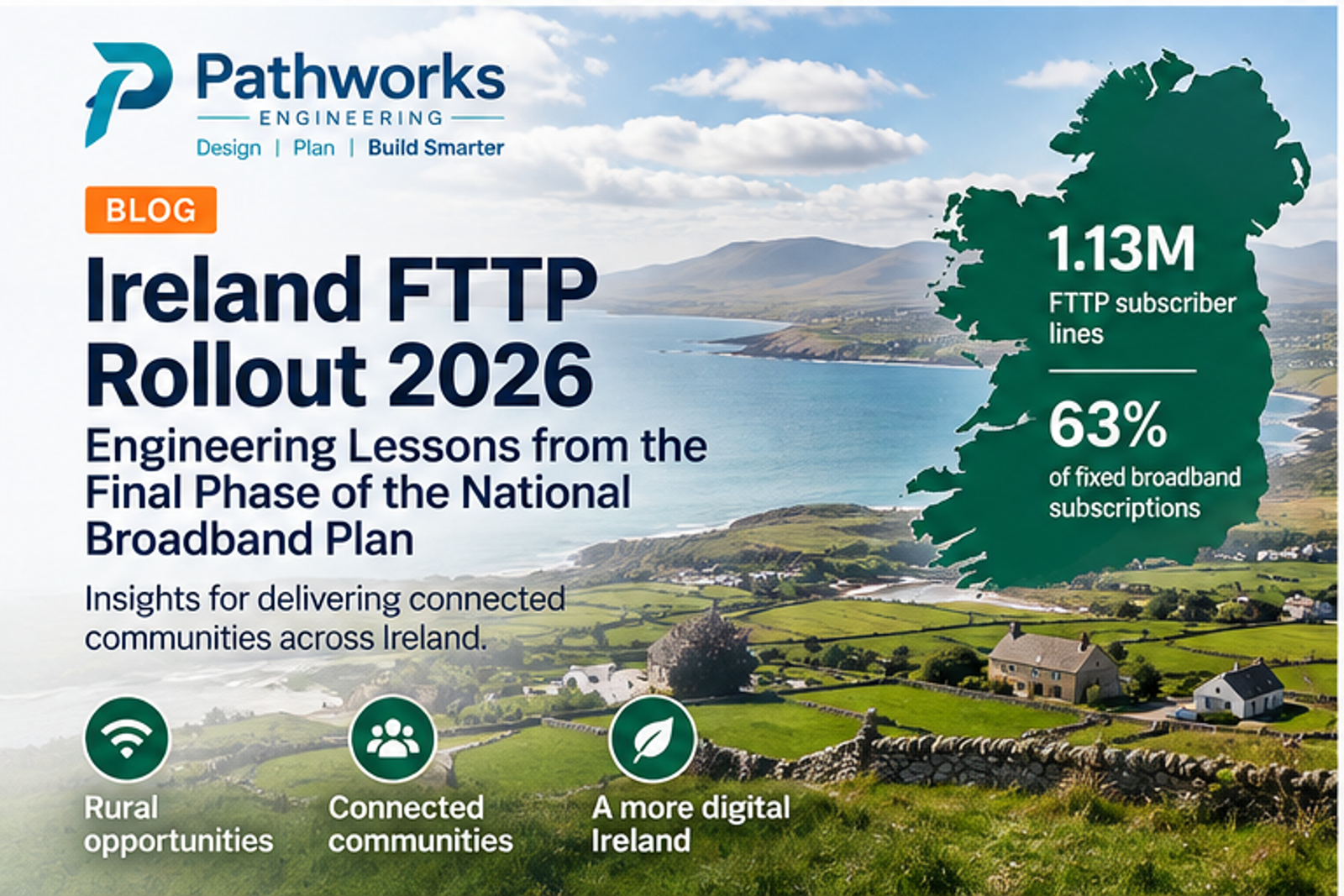
Ireland FTTP Rollout 2026: Engineering Lessons from the Final Phase of the National Broadband Plan
Ireland’s National Broadband Plan is moving through its final build phase across one of Europe’s most dispersed rural footprints. The engineering lessons are highly relevant to every contractor delivering rural FTTP.