
Outsourcing FTTP and OSP Design in the UK & Ireland: A Practical Guide for Fibre Contractors
For UK and Irish fibre contractors, the question is not whether engineering can be outsourced, but which design functions can be externalised without losing control of standards, quality or programme delivery.
Pathworks Engineering
FTTP contractors rarely have a perfectly stable engineering workload.
Design demand rises when a new workbank is released, survey data arrives in bulk, construction teams open multiple fronts or a customer requests accelerated completion. It then shifts towards redesign, redlines, as-builts and close-out.
Maintaining permanent internal headcount for every workload peak can be expensive. Running too lean creates the opposite problem: construction waits for engineering.
That is why outsourced OSP and FTTP design is becoming a practical capacity model for contractors in the UK and Ireland.
But outsourcing works only when the engineering process is controlled properly.
What should actually be outsourced?
The strongest model is not to hand over project ownership. The contractor retains technical governance, client interface and approval authority while external engineers absorb repeatable production and QA tasks.
Typical work packages include:
- HLD drafting
- detailed LLD production
- route updates from surveys
- GIS digitisation and data clean-up
- CAD construction drawings
- splitter and fibre allocation
- cable schedules
- splice diagrams
- BOQ preparation
- design revision cycles
- redline updates
- as-built drawing production
- document QA/QC
These activities can be performed remotely because they depend mainly on structured project inputs, engineering rules and controlled deliverable formats.
Why UK and Irish contractors are different from US clients
The delivery environment matters.
UK projects often involve terminology and processes around PIA, existing Openreach duct and pole assets, chambers, civils, wayleaves and tightly controlled construction packs.
Irish work may involve extensive rural routing, pole and duct surveys, long distribution sections, make-ready dependencies and project-specific requirements from network owners or principal contractors.
A remote engineering partner therefore cannot simply apply a generic FTTH template.
The team must work to the client’s exact standards.
The three risks contractors worry about most
### 1. Quality risk
Will the external designer understand the network or simply draft lines?
The answer should be demonstrated through QA methodology.
A proper design check includes topology, route continuity, asset IDs, fibre counts, splitter allocations, splice relationships, quantities, naming standards and drawing completeness.
### 2. Communication risk
Will timezone or distance slow down decisions?
This is mostly a workflow problem.
Clear issue registers, defined escalation paths and agreed review windows usually matter more than geographic location. A remote team can also use time-zone separation productively: mark-ups issued late in the UK or Ireland working day can be progressed before the next morning.
### 3. Data-control risk
Can project information be handled securely and consistently?
Contractors should define access permissions, file-transfer methods, folder structures, revision rules and document retention requirements before production starts.
External staff should receive only the systems and information required for their scope.
What information should be provided before design begins?
Good outsourcing starts with a complete design basis.
At minimum, the external engineering team should understand:
- client design standards
- project boundary and serving-area logic
- survey format
- available GIS/CAD base data
- asset naming convention
- cable and splitter standards
- symbology and layer requirements
- drawing templates
- BOQ/rate-card structure
- approval workflow
- revision convention
- sample approved deliverables
One approved sample pack is often more useful than a long verbal explanation.
Start with a pilot, not a large commitment
For a new supplier relationship, the most effective test is a contained pilot area.
A contractor can provide one route, serving area or design package and evaluate:
- technical interpretation
- drawing quality
- turnaround
- response to comments
- BOQ accuracy
- documentation discipline
- amount of management attention required
Have a project like this to scope?
A sketch, a photo, or a rough spreadsheet is enough to start.
Start a ProjectIf the pilot works, scaling becomes much easier.
Cost saving should not be the only reason
Remote design can reduce engineering cost, but price alone is a weak selection criterion.
The larger commercial value comes from keeping construction moving.
If a crew, civils subcontractor or splicing team loses a day because the design pack is incomplete, the field cost can easily outweigh the saving achieved by choosing the cheapest drafting resource.
The correct objective is lower total delivery cost.
That means balancing design cost against construction productivity, redesign frequency and close-out quality.
What a strong external team should be able to do
A useful partner should be able to read survey information, understand passive optical topology, identify inconsistencies and produce files that require minimal rework before client submission.
For FTTx projects, competence should cover the relationships between:
- homes or premises passed
- feeder and distribution architecture
- splitter hierarchy
- fibre capacity
- physical route
- closures and jointing
- drop strategy
- optical budget
- bill of quantities
- as-built records
Without that understanding, outsourcing becomes drafting labour rather than engineering support.
How Pathworks approaches remote design support
Pathworks Engineering provides FTTx and OSP design capacity from an experienced telecom engineering team.
Our work can include HLD, LLD, GIS/CAD drafting, survey-data processing, fibre allocation, splice diagrams, BOQs, redlines, as-builts and design QA/QC.
For UK and Irish clients, we work to the contractor’s own standards rather than imposing a fixed internal template. The objective is for deliverables to look and behave like they came from the client’s existing engineering organisation.
A practical engagement can begin with a small pilot route or serving area. That gives both teams a controlled way to validate standards, communication and output quality before increasing volume.
The commercial case
The UK and Ireland are both in mature but still active stages of fibre deployment. The work is shifting from rapid footprint expansion towards harder-to-build areas, infill, completion, customer connections, remediation and as-built control.
That does not reduce the need for design capacity. It changes the type of capacity required.
Contractors that can scale engineering without scaling fixed overhead at the same rate are better positioned to handle changing workbanks.
Outsourcing is most effective when it is treated as an extension of engineering operations, not as a low-cost drafting shortcut.
Pathworks Engineering supports fibre contractors that need additional FTTx/OSP design throughput while retaining full control over client standards and approvals.
Related articles
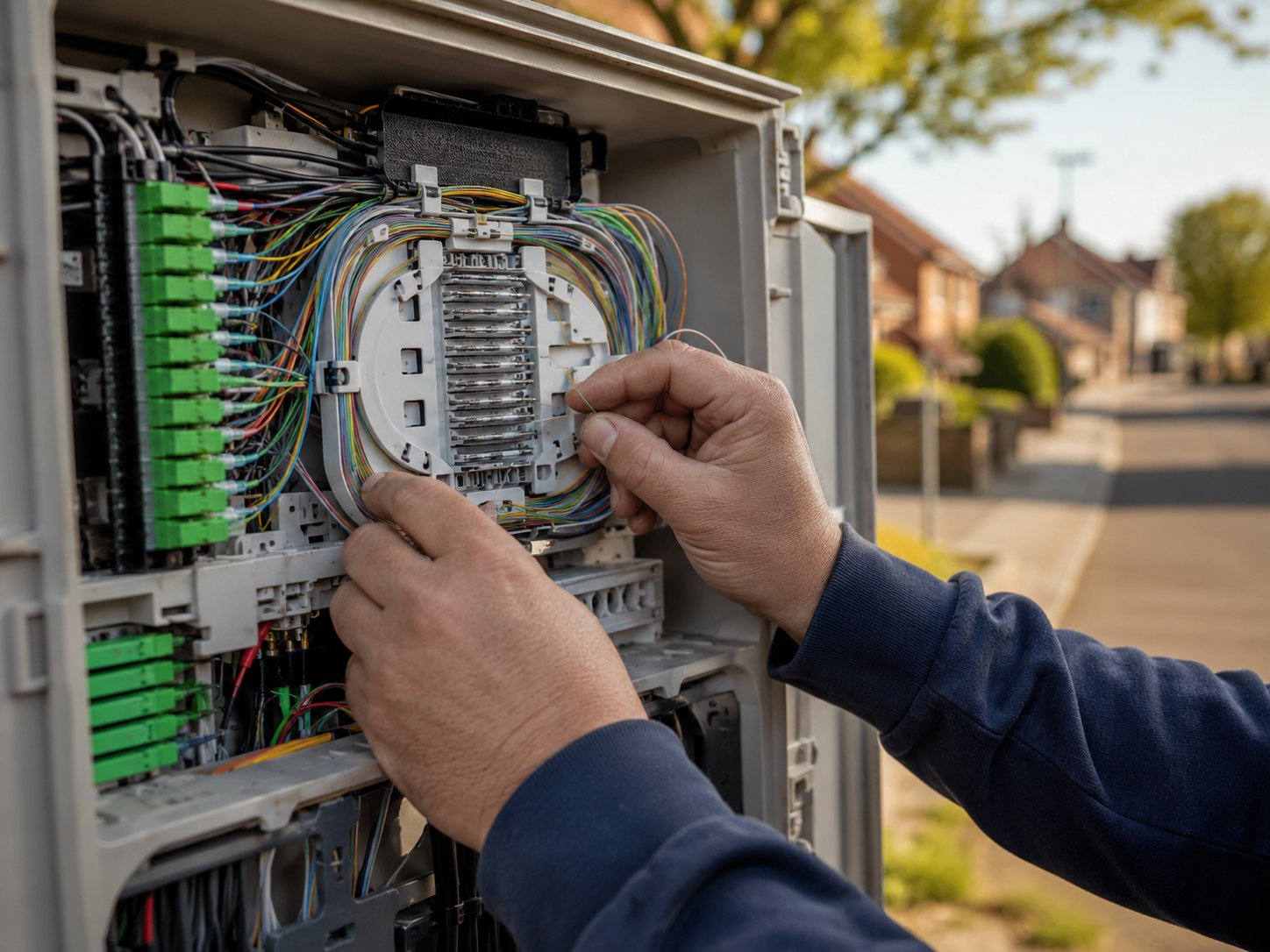

PIA-Ready FTTP Design in the UK: What Contractors Need Before a Build Pack Reaches Site
PIA can reduce the need for new civils, but only when survey, route selection and detailed design are aligned. This practical guide explains what a PIA-ready FTTP build pack should resolve before construction.
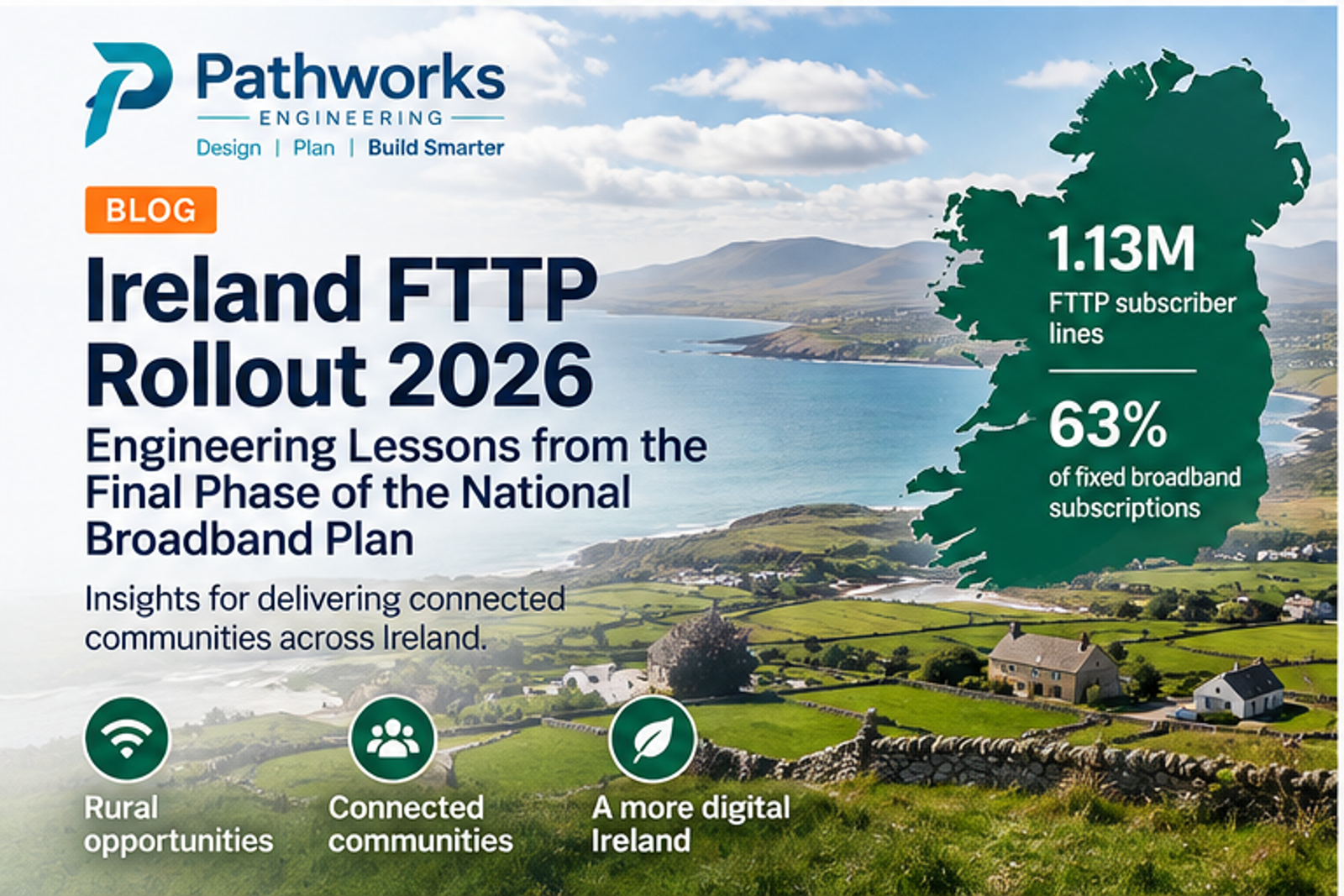
Ireland FTTP Rollout 2026: Engineering Lessons from the Final Phase of the National Broadband Plan
Ireland’s National Broadband Plan is moving through its final build phase across one of Europe’s most dispersed rural footprints. The engineering lessons are highly relevant to every contractor delivering rural FTTP.
UK Full-Fibre Rollout 2026: Why Build-Ready OSP Design Matters More in the Final 20%
With UK full-fibre availability at 82% of homes, the remaining rollout is increasingly shaped by complex routes, civils, PIA constraints and buildability. Here is why stronger OSP design control matters in the final phase.