
PIA-Ready FTTP Design in the UK: What Contractors Need Before a Build Pack Reaches Site
PIA can reduce the need for new civils, but only when survey, route selection and detailed design are aligned. This practical guide explains what a PIA-ready FTTP build pack should resolve before construction.
Pathworks Engineering
Physical Infrastructure Access has become central to many UK FTTP deployment strategies because it allows communications providers to use eligible Openreach ducts and poles rather than building an entirely new passive route.
But access to existing infrastructure does not automatically make a route buildable.
A successful PIA-based design depends on how well survey information, infrastructure records, capacity assumptions, make-ready scope and construction detail are translated into the final design pack.
If those inputs are weak, the apparent saving in civils can be replaced by field delays and redesign.
PIA changes the design question
On a greenfield route, the design question is largely: where should the new infrastructure go?
On a PIA route, the question becomes: which existing assets can be used, under what conditions, and what work is required before the cable can be installed?
Openreach guidance permits eligible communications providers to install cables, blown fibre tubing and/or sub-duct in its ducts and chambers and to attach eligible equipment and cables to its poles, subject to the applicable product rules.
That means a PIA designer has to think at asset level.
1. Start with infrastructure evidence, not a clean CAD line
A route line drawn through a street can look perfect and still be operationally poor.
Before an LLD is issued, the design should be tied back to surveyed chambers, duct sections, poles and known network constraints. Where survey findings differ from records, the discrepancy should be visible and resolved through the project’s agreed process.
Designers should avoid treating unverified connectivity between structures as fact.
2. Make chamber and pole decisions explicit
A construction crew needs to know which assets are being used and what happens at each one.
For chambers, the design may need to identify cable entry and exit directions, jointing requirements, sub-duct use, closure locations and any known remediation issue.
For poles, the pack should provide enough information for the approved field process to confirm attachment feasibility, route continuity and any make-ready work.
The exact attributes vary by client, but the principle is consistent: asset intent should be unambiguous.
3. Separate PIA use from new civils
One of the most important commercial controls in a PIA design is the boundary between existing-infrastructure use and new construction.
A design should make clear where the route remains within existing duct or pole infrastructure and where it transitions into new duct, chambers, crossings or other civils.
Why does this matter?
Because those transitions often carry a large share of delivery cost and programme risk.
If they are hidden inside a general route line, the BOQ can understate the actual scope.
4. Keep topology aligned with physical routing
FTTP topology and physical route design cannot be managed as separate documents.
A change in splitter location can affect fibre allocation, cable size, splice points, cable lengths and downstream distribution design. A blocked duct can force a reroute that changes several quantities at once.
The design workflow should therefore maintain a controlled relationship between:
- GIS or CAD route geometry
- fibre counts
- splitter allocations
- closure locations
- splice schedules
- cable lengths
- BOQ quantities
When one changes, the affected outputs should be rechecked before issue.
5. Design for construction sequence
A technically correct drawing can still be difficult to build.
Good LLDs consider how crews will access the route, install cable, complete joints and progress through the area. Long cable runs with poorly placed access points, unclear jointing locations or unnecessary route transitions can reduce productivity.
Have a project like this to scope?
A sketch, a photo, or a rough spreadsheet is enough to start.
Start a ProjectThe best design is not simply one that fits the network model. It is one that can be executed efficiently in the field.
6. Build assumptions should be visible
No design team has perfect information.
The problem is not uncertainty itself. The problem is undocumented uncertainty.
If a section is subject to final rodding and roping, wayleave confirmation, traffic management, pole assessment or field verification, that dependency should be identified in the project’s normal design notes or issue register.
This helps construction managers distinguish between confirmed scope and conditional scope.
7. The BOQ should be an engineering output
A BOQ should not be prepared as a separate commercial exercise after the design is complete.
It should be generated and checked from the final route and topology.
Typical quantities may include cable by size, sub-duct, closures, splitters, jointing items, chambers, new duct, pole-related items, drop materials and route-specific civils.
The exact schedule depends on the client’s rate card and scope, but the quantities need to reconcile to the design that has actually been approved.
8. QA before issue is cheaper than redesign after mobilisation
Before a PIA-based build pack reaches site, an independent or second-level design check should verify at least:
- route continuity
- asset IDs
- cable continuity and fibre counts
- splitter allocations
- splice relationships
- cable lengths
- civils transitions
- BOQ consistency
- naming and drawing standards
- revision status
This is where many avoidable site queries can be removed.
PIA is an engineering workflow, not only an access product
The value of PIA comes from reusing infrastructure that already exists. The value of good PIA design comes from making that reuse predictable.
As the UK FTTP rollout enters more complex areas, contractors need design packs that help crews move without repeatedly stopping for clarification or redesign.
Pathworks Engineering supports UK telecom contractors with OSP route design, HLD/LLD production, GIS/CAD drafting, BOQs, splice documentation, redlines and as-built updates. We work to client-defined standards so the external design team becomes an extension of the existing engineering workflow rather than a separate process.
Source context: Openreach Physical Infrastructure Access guidance and current UK full-fibre rollout information.
Related articles


Outsourcing FTTP and OSP Design in the UK & Ireland: A Practical Guide for Fibre Contractors
For UK and Irish fibre contractors, the question is not whether engineering can be outsourced, but which design functions can be externalised without losing control of standards, quality or programme delivery.
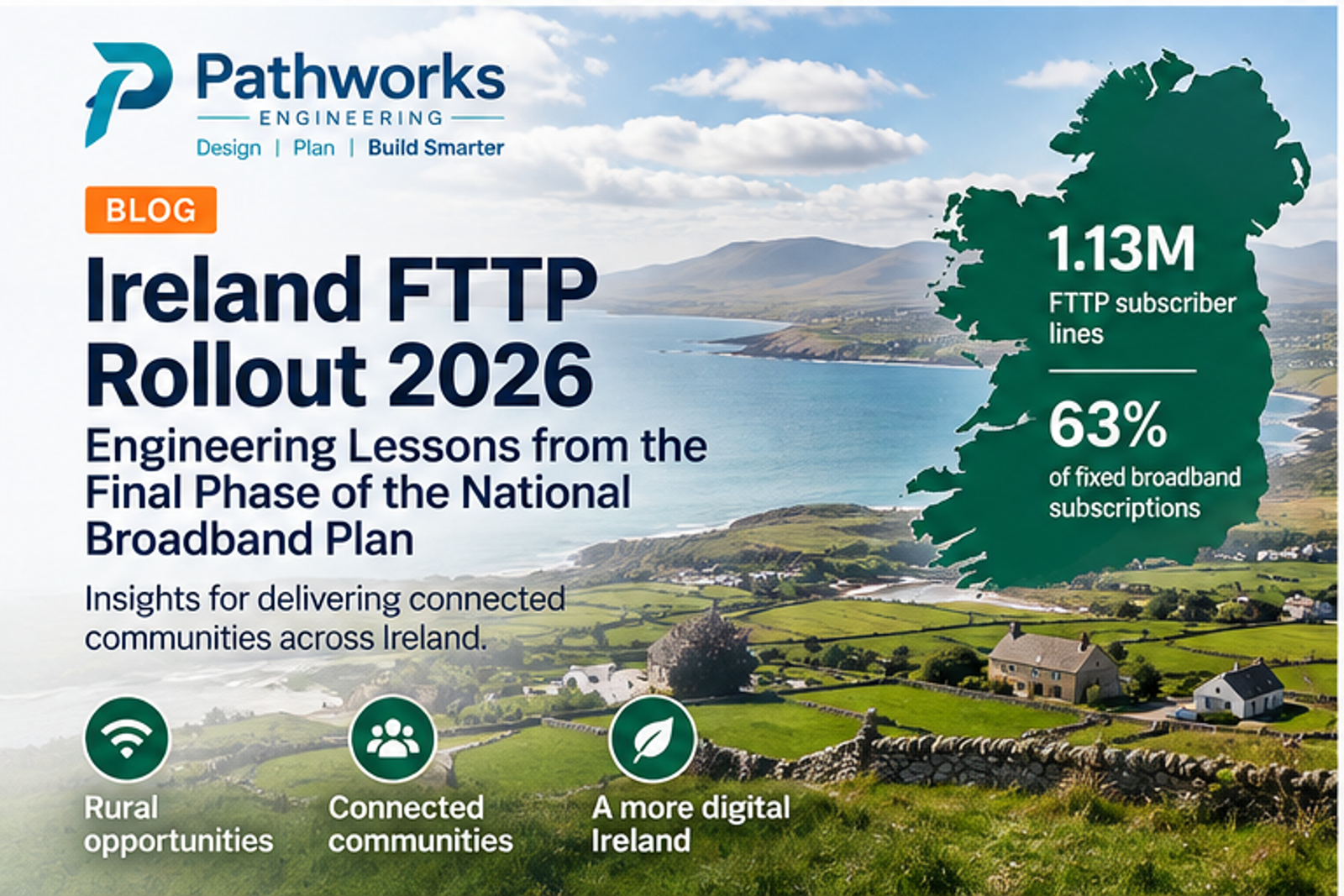
Ireland FTTP Rollout 2026: Engineering Lessons from the Final Phase of the National Broadband Plan
Ireland’s National Broadband Plan is moving through its final build phase across one of Europe’s most dispersed rural footprints. The engineering lessons are highly relevant to every contractor delivering rural FTTP.
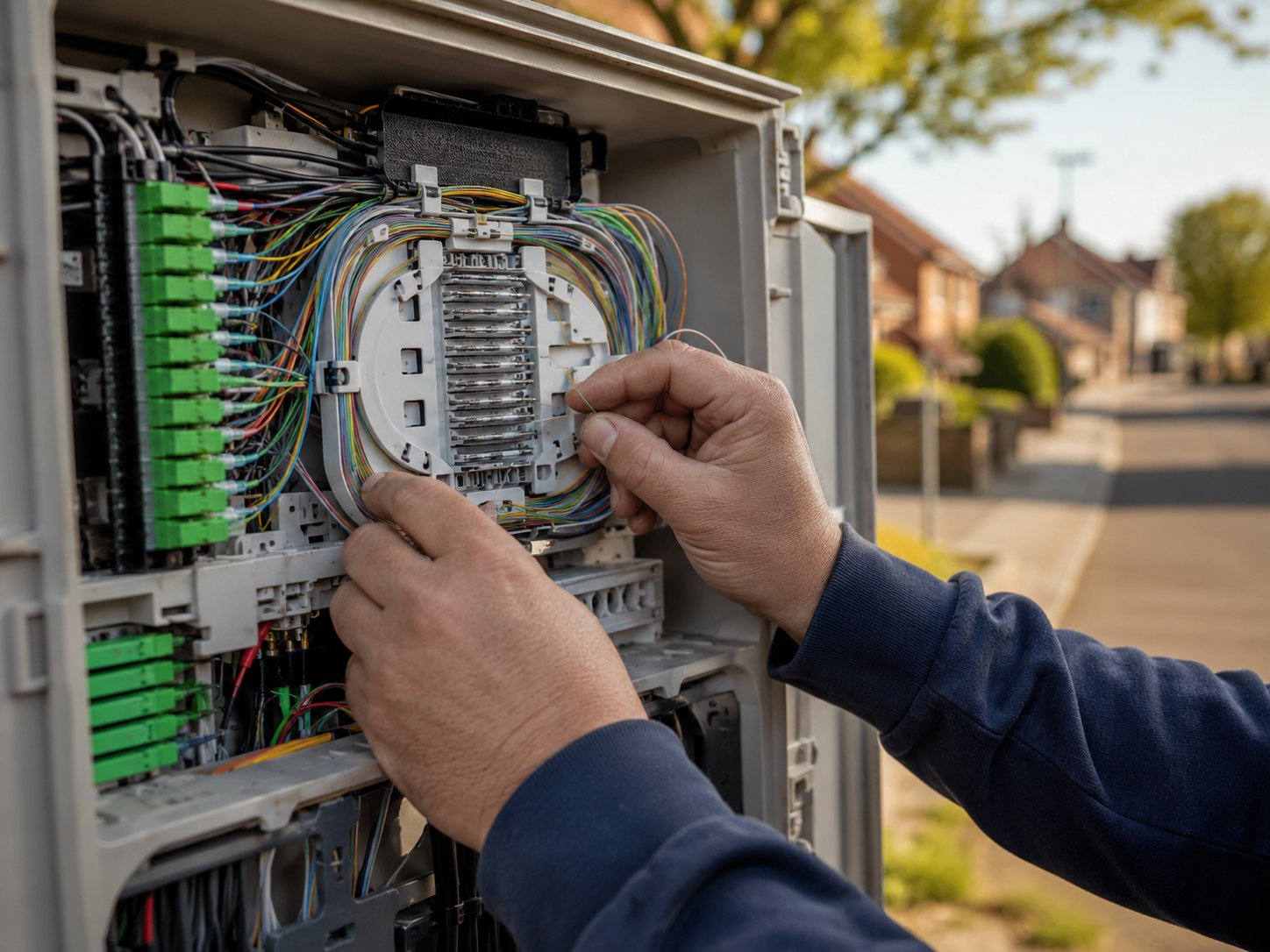
UK Full-Fibre Rollout 2026: Why Build-Ready OSP Design Matters More in the Final 20%
With UK full-fibre availability at 82% of homes, the remaining rollout is increasingly shaped by complex routes, civils, PIA constraints and buildability. Here is why stronger OSP design control matters in the final phase.