
What Makes a Fiber Network Design "Build-Ready"? A Practical Checklist
A design that looks finished on screen isn't the same as a design a construction crew can actually build from. Here's the checklist we run every LLD package against before it goes out the door.
Pathworks Engineering Team
A lot of network designs die between the design review and the construction crew. The HLD looked right, the LLD had all the right layers, and then someone in the field found a duct that didn't exist, a pole with no spare capacity, or a splice point with no clear ownership. "Build-ready" is a specific, checkable standard, not a synonym for "finished."
Route feasibility has been checked against real constraints
Satellite imagery and street-level photos catch a lot, but not everything. A build-ready route accounts for existing duct occupancy, pole ownership and make-ready status, and any obvious right-of-way conflicts. If a route depends on an assumption ("we assume this duct has spare capacity"), that assumption needs to be flagged explicitly, not buried in a note nobody reads.
Every splice point has a diagram, not just a symbol
An FDH or closure marked on a route map is a placeholder, not a design. Build-ready means every splice point has a diagram showing fiber counts in and out, slack storage, and a splicing schedule that a technician can follow without calling the design office to ask what a symbol means.
The BOQ matches the drawing, line for line
This sounds obvious and is the single most common failure point we see in packages handed to us for QA review. Duct lengths, cabinet counts, and closure counts in the bill of quantities should tie out exactly to what's drawn. A mismatch here doesn't just slow procurement; it usually means the drawing changed after the BOQ was generated and nobody reconciled the two.
As-built capture is planned before construction starts, not after
Redline conversion is far cheaper when the construction crew knows from day one what needs to be marked up and how. Build-ready packages specify the as-built capture format up front (which fields, which precision, which file format) so the record update at the end isn't a separate, expensive project of its own.
Have a project like this to scope?
A sketch, a photo, or a rough spreadsheet is enough to start.
Start a ProjectThe package survives a reviewer who wasn't in the room
The real test: hand the package to an engineer who had no part in the original design conversation. If they can build from it without a clarifying call, it's build-ready. If they can't, the gaps are usually exactly the four points above.
We run every HLD/LLD package we deliver against this checklist before it ships, whether the starting point was a full survey dataset or a single marked-up map photo.
Related articles
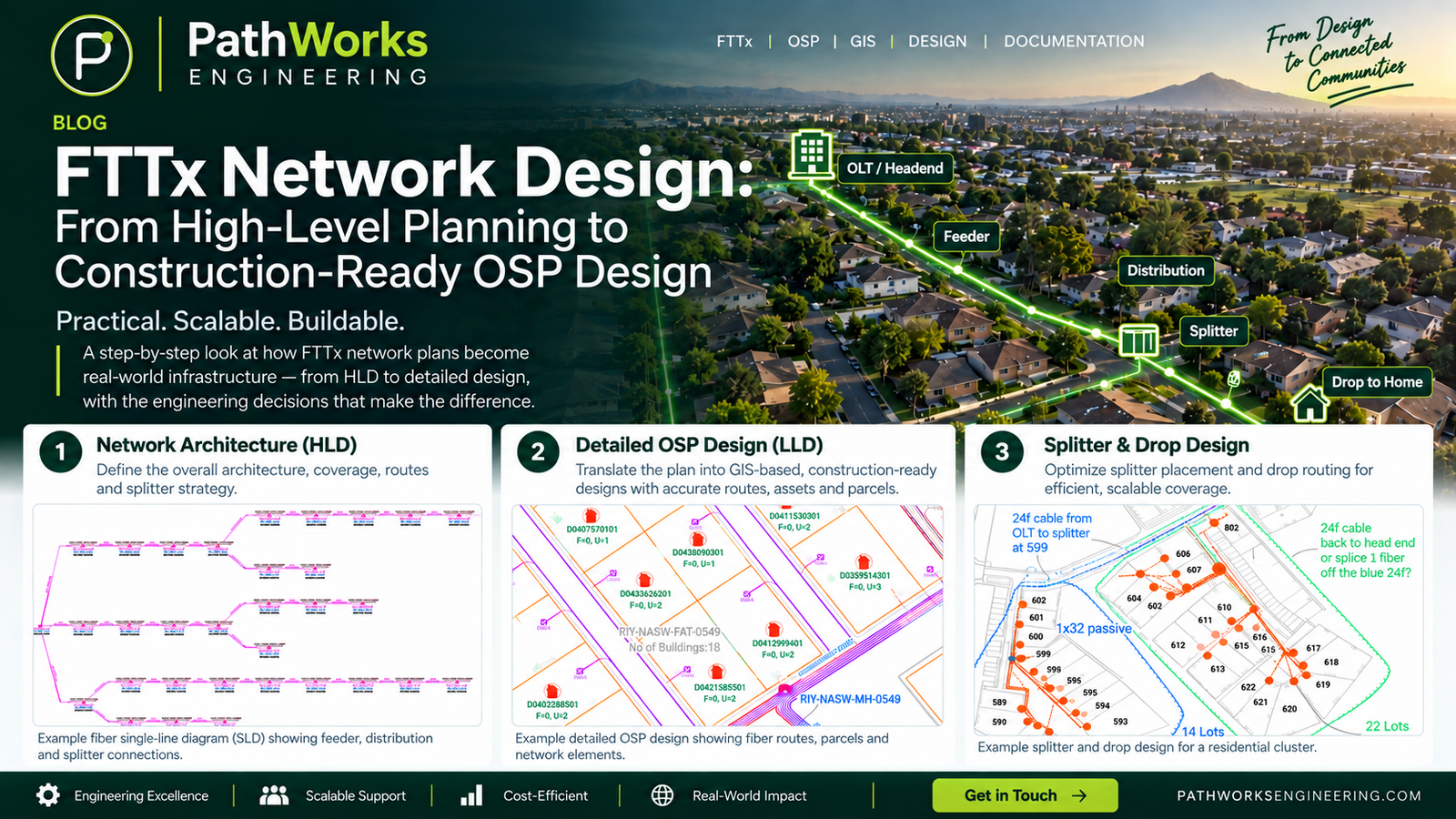

FTTx Network Design: From HLD to Construction-Ready OSP Engineering
A practical guide to FTTx network design, covering HLD, LLD, splitter planning, fiber topology, BOQ development, QA/QC and construction-ready OSP documentation.
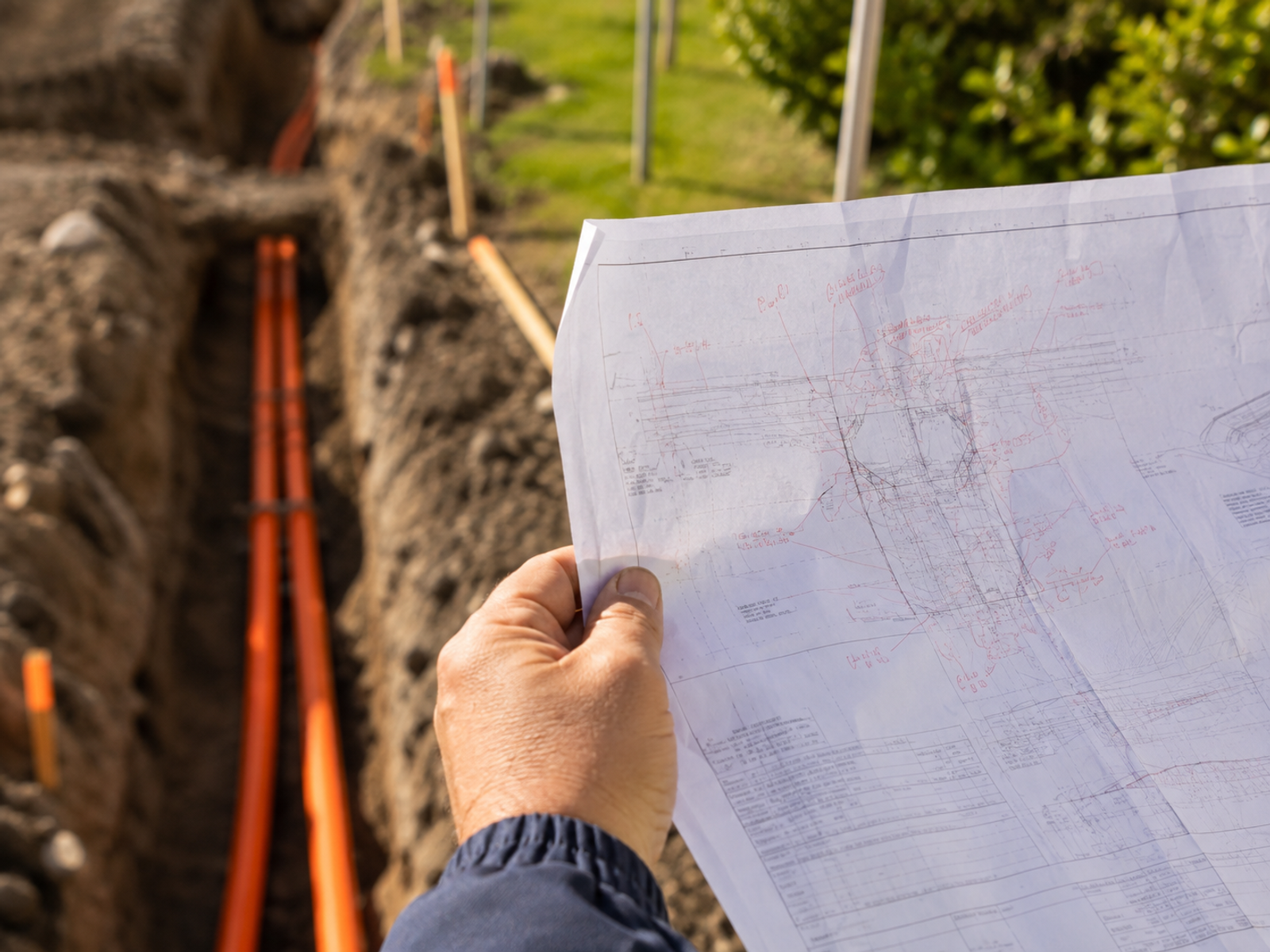
As-Built Redlining: Why the Built Network Stops Matching the Design, and How to Control the Drift
The network in the field and the network on the drawing start drifting apart the moment construction begins. Here's how to control that drift instead of discovering it years later.
GPON Power Budgets: Sizing Split Ratios Against Real Receiver Sensitivity, Not the Datasheet Ceiling
Sizing a split ratio off the datasheet ceiling looks fine on paper and fails in the field. Here's how to budget against real receiver sensitivity instead.